HelixCore · Precision Genomics. Unlimited Power.
What it delivers How it learns The finding Modules Your data
Docs Sign in
HelixCore · intelligence applied to molecular biology

It doesn't just apply science. It extends it.

Every bioinformatics platform executes what the literature already knows. This one reasons over that knowledge until it finds what is missing — and in its first validation it corrected the virulence paradigm of a pathogen the field had considered settled for a decade. Meanwhile, it resolves in a single pass the work that today takes an expert team weeks, and delivers first-quartile rigour in language the person who has to decide can actually read.

What it delivers How it grows wiser
Corpus under continuous ingestion
Taxonomy
Bacteria, fungi, viruses and eukaryotes, with clonal typing and barcode markers.
Resistances
Antimicrobial resistance determinants and their genomic context.
Virulence
Virulence factors, gene function and their pathways.
Physiology
Growth requirements, metabolism and ribosomal copy number.
Kinetics
Growth and inactivation profiles with their environmental modifiers.
Regulatory
Microbiological criteria and European legislation, versioned by amendment.
Verdict
Declarable allergens and reference transgenic constructs.
Literature
Every statement anchored to the publication that supports it.
70+ node types · 40+ relationship types
Curated, versioned, with a DOI per node
39.1%
of industrial strains carry virulence and persistence at once. The prevailing paradigm said it was impossible.
1
paradigm corrected in the system's first validation. A decade of literature, revised by an in-house finding.
6
orthogonal methods cross-checked by consensus to find a target. Common practice relies on one.
10,000
simulated scenarios in every shelf-life study: the report arrives with its 95% confidence interval.
01 What it delivers

Q1 rigour. Readable by whoever decides.

That balance is the one nobody solves. Academic tools produce illegible rigour: raw tables that need a bioinformatician to interpret. Commercial ones produce legibility without rigour, and with little power underneath: green lights held up by an engine that cannot cope with a difficult sample. HelixCore delivers both in the same document — the full reasoning with its references, and on top of it the conclusion the quality director can sign on Monday.

Raw data goes in as it is
Files from the sequencer, the thermocycler or the lab. No preprocessing, no prior conversion, no deciding up front which tool applies.
The method picks itself
The system recognises the platform, the marker and the matrix, and applies the right pipeline with its parameters. The analyst does not configure: they review.
The full reasoning comes out
Every conclusion with its evidence chain, its declared uncertainty and its checkable references. Defensible before a reviewer and before an auditor.
And the decision comes out
The same job delivers the operational document: what to do, why, on what regulatory basis, and how to verify it worked.
The work that disappears Chaining four or six disconnected tools, reformatting between every hop, rebuilding the documentation by hand from scattered results, and starting over when the sequencing platform changes. That is what consumes the analyst today, and it is not science: it is plumbing.
02 How it learns

It knows more today than yesterday. Literally.

Every bioinformatics tool on the market is identical the day you install it and the day you uninstall it. It changes when someone ships a release. HelixCore does not: its knowledge is a living organism that grows along three simultaneous paths, and two of them require nobody to do anything.

01 Ingestion
Everything that gets published
Eight domains of biological knowledge under continuous ingestion from international reference sources. The field advances and the system keeps up without anyone intervening.
02 Experience
Everything you correct in it
Every validation or rejection by an expert reinforces the correct relationships and weakens the wrong ones. Your team's judgement ends up distilled inside the system, not in the head of whoever leaves.
03 Reflection
And what it deduces on its own
With nobody asking, it crosses what it knows with what it has seen and proposes relationships the literature has not yet described. New knowledge, generated as a by-product of daily work.
What nobody else does
In its spare time, HelixIA “thinks” about what it knows.
Between jobs it revisits its own knowledge in the light of what it has seen: it crosses what it knows with what it has observed, detects relationships the literature has not described, and proposes them as hypotheses. It is not a query someone launches. It is a permanent process. The result reaches the curation panel, where an expert decides whether new knowledge has just appeared.
And every installation is different
A meat plant in Norway and a dairy in Extremadura accumulate different corrections because they see different problems. After N cycles, an active user's knowledge is qualitatively superior to the starting point — and specific to their operating context. Without a single extra line of code.
That accumulated knowledge is not a usage log: it is an asset that grows in value over time and cannot be bought ready-made.
Observes
The system detects a relationship absent from the literature but derivable from what it already knows.
Proposes
It frames it as a hypothesis, with the reasoning chain that supports it and its confidence level.
An expert decides
They review it with the references in front of them: approve, qualify or discard. Five minutes of human work.
It comes to know it
Once approved, it stops being a hypothesis and becomes knowledge available to all twelve modules, instantly and with nothing to integrate.
A real example: the system observes that a certain gene alters behaviour in a dairy matrix. A curator validates it with two references. From that instant, the shelf-life module uses it when predicting expiry, the metagenomics module when it sees it in a sample, and the quantification module when computing load. One curated decision, capital reusable across the whole constellation.
03 How it reasons

Creativity with traceability.

A loose model is creative but not traceable. A rule system is traceable but not creative. Here reasoning happens over curated knowledge, and every statement comes out labelled with its evidence tier. The documented, the derived and the hypothetical never mix in the same output.

Documented
What the literature says
Exact lookup over curated knowledge: genes, kinetic profiles, regulatory criteria, allergens. Each with its references attached.
confidence0,85 – 0,99
audit trailreference per node
Derived
What follows from it
Multi-hop reasoning over canonical biological patterns: cross-feeding, antagonism, compensation, footprint propagation, regulatory inheritance.
confidence0,50 – 0,85
audit trailchain of steps
Hypothesis
What the system suspects
Undocumented but derivable relationships. They never reach the operational user: they go to the curation panel, where an expert validates or discards them.
confidence0,20 – 0,60
audit trailhuman curation
Invariant · non-negotiable
Every reference the system cites is verified against the graph's own literature. If the article does not exist, the citation is rejected.
A HelixCore statement cannot rest on an invented source: the arbiter is the curated knowledge, not the model.
Filter by destination
The regulatory dossier accepts documented evidence only. No exceptions.
regulatory dossierdocumented
technical reportdocumented + derived
curation paneleverything, hypotheses included
04 A real inference

This is where HelixCore saves you from an expensive mistake.

A genome of Listeria monocytogenes carries inlA with a premature stop codon at position 492. Standard classification calls it safe. Here is what happens next, step by step.

Conventional classification
Reduced risk
Loss of functional InlA removes E-cadherin-mediated invasion of enterocytes. Current systems stop here, because they assess each marker in isolation.
01
Truncated inlA removes the primary intestinal invasion route. So far, this matches the standard.
02
But the genome carries a complete inlF + inlJ cassette, with an intact PrfA box upstream — indicating functional transcriptional regulation by the master virulence regulator.
03
inlF mediates hepatocyte invasion via the c-Met receptor: a route independent of E-cadherin.
04
In a hypervirulent CC1 context, the intracellular survival machinery is fully operational — complete LIPI-1, functional actA, functional hly.
05
Therefore the alternative systemic invasion route remains functional despite the truncation.
HelixCore's conclusion · contradicts the standard
Systemic invasion risk is NOT reduced. Keep the high-risk classification.
Compensatory reasoning: the loss of function in one gene is covered by an alternative route whose functionality depends, in turn, on a third regulatory element. Beyond the reach of any system based on the presence or absence of individual markers.
05 The finding

One in three strains contradicted the paradigm. Nobody had seen it.

For more than a decade, the microbiology of Listeria monocytogenes has rested on a principle established by the Institut Pasteur: hypervirulent lineages and plant-persistent lineages are distinct groups. A strain either invades well or survives cleaning well; not both. That trade-off underpins how clinical risk is classified and how hygiene plans are designed in the food industry.

It is false in a third of cases.

It emerged during GIFCloud's validation. While processing the verification panel's genomes, the system detected a cluster that fitted no known category: strains carrying at once the genomic repertoire of high virulence and that of high persistence. It was described as amphitrophism, a third ecological strategy of the species.
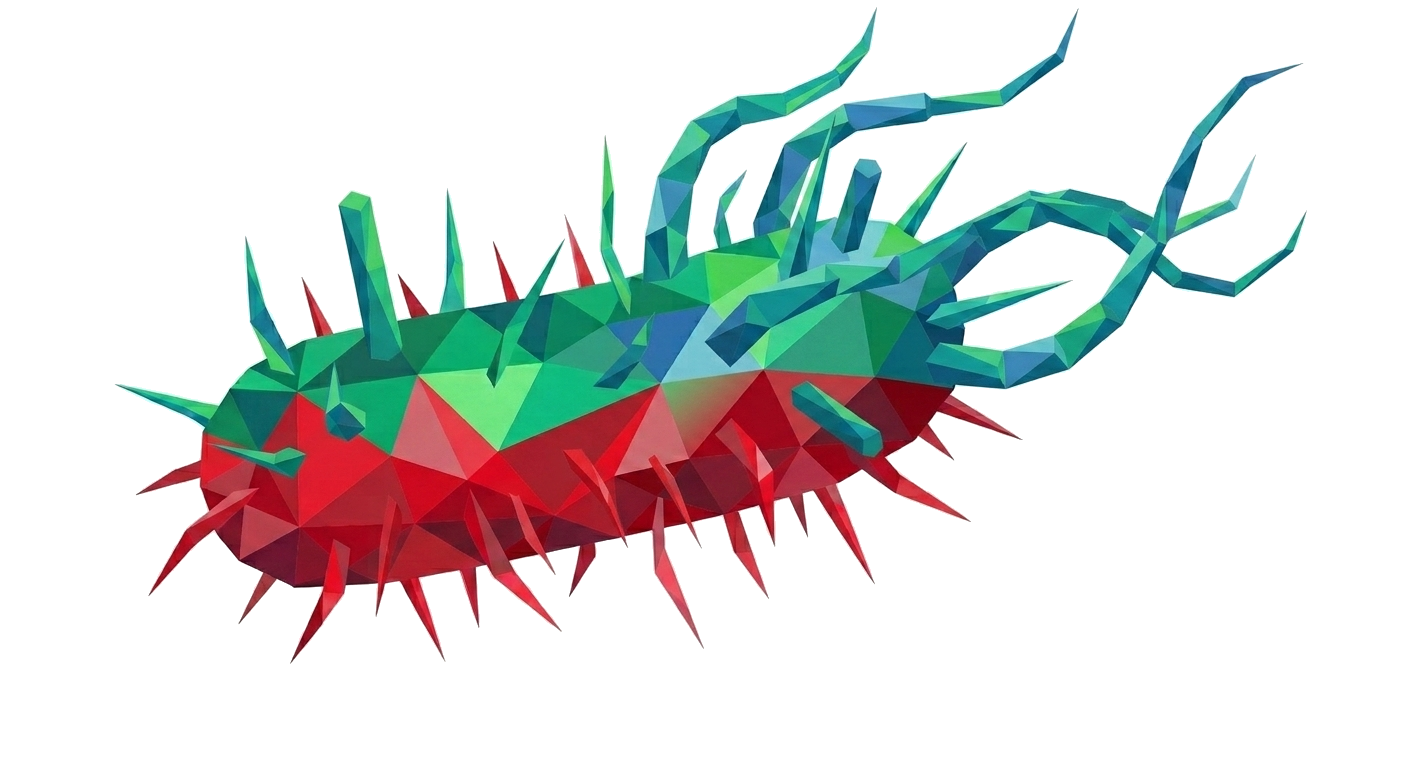
Amphitrophic strain: virulence and persistence at once
Prevalence of the amphitrophic genotype
39.1%
of strains isolated in an industrial context
31.0%
of strains isolated in a clinical context
Gamboa J., 2026 · preprint on bioRxiv
doi.org/10.64898/2026.03.23.713700
Clinical consequence
A third of clinical isolates may have been classified below their real severity.
If the framework assumes a persistent strain is weakly virulent, an amphitrophic strain reads as moderate risk when it is high. That error is not in the lab: it is in the criterion used to interpret the result, and therefore repeats systematically.
Industrial consequence
And hygiene plans were designed against the wrong enemy.
Plant persistence has been treated as a cleaning problem with no clinical aggravation. With a third of industrial strains amphitrophic, a hygiene failure stops being an inefficiency and becomes direct exposure: product recalled, batch affected, and severe illness in vulnerable populations.
And this is what really matters
It was not luck. It is what the system was built to find.

Behind it lie years of hard research: marker panels validated until proven sufficiently informative and robust, thousands of genomes processed, and a reasoning engine built to back every statement with its evidence chain. We did not stumble on amphitrophism by accident: it came out of GIFCloud's validation campaign because the system was designed to see it. And it does not stop at a headline — it follows the usual circuit: a preprint published with a DOI and papers under peer review. The platform in production generates findings of this nature as a secondary output of daily work. That is the ambition, and it is not rhetoric: that it should not merely apply the science of the field, but extend it.

06 The modules

Twelve specialists. A single mind.

Each masters its vertical. None reimplements the knowledge: all of them read — and enrich — the same shared memory.
01
GIFCloud
Surveillance · WGS pathogens
Pathogen risk interpretation from whole genomes, through an operational, scientific and compliance lens.
production
Its edge
For the first time it identifies the real, intrinsic risk of every strain isolated in the plant, and translates it into decisions that are understood and executed on the line. It is personalised medicine for sanitation: instead of one protocol for everyone, the one that matches the strain actually living there.
Typing tells you which strain it is and where it came from. It does not tell you what to do with it. That is where the work that matters begins: the same data that Regulation 2025/179 makes it prudent to control proactively turns into an optimised operation — less time, less cost.
Core
Virulence, persistence and context detectors, version-sealed and reproducible.
Patterns
Five canonical plus three plant-specific operational ones.
Compliance
Automatic mapping to IFS and BRC requirements and European regulatory clauses.
02
FoodSpan
Predictive microbiology · shelf life
Shelf life computed from metagenomic microbiological panels, with four primary models, the gamma concept and an audit-ready report.
production
+
Its edge
The only one that computes shelf life from metagenomic microbiological panels: all the informative power of the traditional panel, plus the granularity of knowing exactly which species sit behind each label. From each species it derives its metabolic capabilities and, with its kinetics, the forecast of spoilage or safety failure. The next generation of the shelf-life study.
The classic study models an aggregate label — total aerobes, lactic acid bacteria — and returns a number. Here the full kinetics is reconstructed at any instant with top-tier validated predictive microbiology, species by species: not how much a count rises, but which organism spoils the product, through which metabolic route and when.
Model
Le Marc-Coroller extended with eight undissociated organic acids, CO₂ by Henry's law, NaCl and smoke phenols.
Simulation
Baranyi with Monte Carlo at ten thousand iterations and a percentile band.
Verdict
Tree aligned with EFSA BIOHAZ, with a 95% confidence interval and a conservative 95th-percentile shelf life by default.
03
OmniOta
Ingestion · metabarcoding
Processes raw data from any platform through to taxonomy, diversity and a publishable report, choosing the optimal engine by itself.
production
+
Its edge
The most powerful high-resolution metagenomics on the market, and the benchmark is published so you can check it: measured against every relevant competitor, on their own datasets and with their own metric. Shotgun or amplicon, agnostic to the target region, with nine orthogonal quality-control layers. And not only on perfect genomes under ideal research conditions: it is tuned for the real sample, the low-quality one that arrives daily in the food industry.
A research classifier shines on clean material; this one is production grade. Traceable end to end, no black box, and it delivers the full report on its own: advanced interpretation, metabolic potential, Sankey diagrams, diversity analysis. Where the state of the art identifies by exact match and falls silent on degraded DNA, here there is still an answer.
Detection
Reads the file headers to identify Illumina, Nanopore or Ion Torrent.
Engines
Four classifiers, with EMU for 16S on Nanopore, where the rest fail on homopolymers.
Output
A roughly ten-page report with methods, figures and tables, ready to publish.
04
DeLorean
Quantification · regulatory
Converts relative metagenomic abundances into absolute reportable units, calibrating against historical culture data.
production
+
Its edge
The only one that turns metagenomics into reportable units by declaring its bias instead of hiding it. It quantifies on viable-cell metagenomics: differential pre-lysis and DNase before sequencing, so DNA free of already-dead cells never enters the count. And where that filter cannot reach — the spore is impermeable to DNase and its DNA survives — the report gives the sign and the magnitude of the excess instead of a clean, false number.
The conversion factor is not an invented constant: it is an empirical prior with its mechanism and its reference, which the engine fuses with real metagenomics–culture pairs by Bayesian shrinkage, so the prior washes itself out as data arrives. The prior is independent of the validation set — anti-circularity rule — and the metrics stay out of sample.
Correction
Normalises by ribosomal gene copy number against a curated base of more than one hundred and twenty-six food taxa.
Protocol-dependent bias
A molecular bias with no declared protocol cannot be interpreted: with standard extraction the spore is under-detected, with a viability filter it is over-detected. Every figure comes out with the axis on which it is true.
Trayectoria
The molecular excess is not constant: it decays as the spore germinates and the damaged cell recovers. In a real series, sulphite reducers +5.88 → +2.94 → +1.81 log; enterobacteria +4.60 → +1.57. A growing bias is rejected for contradicting the mechanism.
What the plate cannot see
Selective media count presumptive, overlapping groups: enterobacteria ⊇ coliforms ⊇ E. coli triples the same isolate, and one enterococcus lands both in lactic acid bacteria and in its own count. Resolving to species undoes the double counting.
Datos censurados
A “<10” is replaced by 10 — the EFSA/WHO precautionary convention — not by half the detection limit, which is a chemistry criterion, nor by exclusion, which biases downwards.
Honest curation
Only the mechanism and the sign are admitted as curated; the numbers travel as pending, with their n and their R². The trajectory is clean within a single series and dilutes when studies are pooled — and that is stated.
Validation
Lin's concordance, Passing-Bablok, Bland-Altman and temporal drift detection.
Limit
CFUeq/g is a calibrated culture equivalent, not a plate count: it includes viable but non-culturable cells, which is exactly what the plate cannot see. For formal regulatory validation it is complemented with culture to the ISO standard.
05
HoloGen
Ingestion · whole genome
Assembly, annotation and a navigable circular map of an isolate's genome, with epidemiological typing.
production
+
Its edge
The assembly does not end in a file: it feeds straight into target discovery and risk interpretation without leaving the system.
The alternative is chaining assembler, annotator and viewer by hand, and re-exporting at every hop.
Input
Pure-isolate reads. Mixed samples go to OmniOta.
Closure
Phased closure engine, with an explicit verdict at every long step.
Chains to
Direct output to BioMiner and GIFCloud.
06
BioMiner
Discovery · targets
Discovers diagnostic genomic regions by combining six orthogonal methods with automatic cross-consensus.
production
+
Its edge
The k-mer analyser performs peak detection over k-mer space: it captures diagnostic regions in rearranged genomes that aligners miss entirely.
Geneious, CLC and Ridom SeqSphere do not offer k-mers, pangenome, variants and structure in one integrated pipeline with inclusivity validation.
Consensus
Regions found by two or more methods receive an exponential confidence boost.
Reach
What takes an expert weeks of chained analyses comes out here ranked.
Inclusivity
Verifies the target is present in every target genome, not just one strain.
07
SnapPrime
Design · primers
Designs primers in standard, probe and HRM modes, simplex and multiplex, with thermodynamic validation and an institutional repository.
production
+
Its edge
The only one designing universal primers by consensus: it profiles conservation over a multiple alignment, tolerates synonymous variation and validates with a biochemical 3′-end extension rule.
Primer3, PrimerQuest and Beacon Designer do not combine intelligent consensus with biochemical extension validation.
Multiplex
Simulated-annealing optimisation that minimises cross-dimers and enforces size separation.
Scoring
Seven weighted dimensions, from melting temperature to secondary structures.
Time
Minutes, against the hours per target of manual design.
08
DigiCycler
Validation · in silico
Predicts whether a primer pair will amplify its target and reject the exclusions, with real biophysical rigour.
production
+
Its edge
This is not a BLAST with a nice name: it integrates alignment, nearest-neighbour thermodynamics, a biochemical 3′ extension model and amplicon structure prediction in a single pipeline.
Conventional BLAST only checks homology: it ignores thermodynamics, accessibility, secondary structures and dimers.
Factors
Ten biophysical factors on the target and three progressive layers on the exclusions.
Veredicto
Six levels, from validated to non-functional, with the reason for every rejection.
Basis
Sixteen published references support the model.
09
Hermes
Instrumentation · qPCR and dPCR
Interprets the raw data coming off the thermocycler: curves, threshold cycles, melting curves and partitions.
design
+
Its edge
It closes the loop with the real lab: what was predicted in silico is checked against what the instrument measured, and that comparison flows back into the knowledge.
Today that comparison is made in a spreadsheet and lost the moment the file is closed.
Input
Standard instrument files with their complete curves.
Output
Interpretation carrying the traceability of the design that produced those primers.
Status
In design.
10
FastKit
Delivery · product
Turns a validated design into the complete kit: protocol, controls, usage cards, purchase orders and dossier.
production
+
Its edge
It is the point where a genomic discovery emerges as a documented product without ever changing systems along the way.
The norm is rebuilding the documentation by hand from results scattered across five different tools.
Knowledge
Reads allergens, transgenic constructs and markers from the curated knowledge.
Output
Bilingual protocols, controls, purchase orders and regulatory documentation.
Signature
It prepares the dossier; the declaration of conformity is signed by the manufacturer.
11
Helion
Clinical · genetic diagnostics
Turns the patient's phenotype into a prioritised genetic testing plan, fully traceable.
production
+
Its edge
It runs on explicit code: every recommendation is traceable to a concrete rule, which is exactly what regulatory auditability demands.
Exomiser and Amelie use models that are hard to audit. A laboratory that must document its clinical reasoning cannot defend a black box.
Phenotype
Human phenotype ontology over a directed graph, with information-content semantic similarity.
Evidence
Three tiers according to the variant's review level in the reference clinical databases.
Escalation
Panel, exome or whole genome depending on differential coverage and available evidence.
12
NoGMO
Authenticity · GMOs
Detection and verification of transgenic constructs for GM-free product certification.
production
+
Its edge
It shares memory with the rest: the constructs curated here are used by the kit generator to issue the corresponding assay.
Certification services outsource the assay and return a certificate with no traceability to the method.
Knowledge
Curated transgenic constructs, with their associated regulatory basis.
Chains to
Direct output to FastKit for the verification kit.
Scope
Authenticity and labelling certification.
07 Your data

It learns from your judgement. Not from your genomes.

That distinction is what holds up everything above. What enriches the shared knowledge is the curated decision — that a given biological relationship is true — never the sequence, the project or the result that produced it. Your material enters no common index.

And if you prefer that not even the decision leaves the building, the curated knowledge can stay in your own installation.


What is never indexed
Your sequences, assemblies, projects and results. They enter no shared index and are not used for training.
How they are queried
With your token and only within your organisation. Every access is logged with who, when and what.
What is shared
The curated scientific knowledge: literature, taxonomy, resistances, regulation. What is already public, kept up to date.
Isolation between customers
Your team's corrections tune your installation. No organisation sees, inherits or infers another's judgement.
Aegis Cross-cutting · security and audit
It wraps the entire constellation: access control and an auditable record of every query to every module. It is not a module you have to integrate with — it is the layer everything passes through, by construction. Without it, the paragraph on the left would be a claim; with it, it is a verifiable record.
HelixCore · Precision Genomics. Unlimited Power.

Stop doing plumbing. Focus on doing science. Or on applying it.

Request access Talk to the team
BIOTECNO.org · Vitoria-Gasteiz EU + Codex